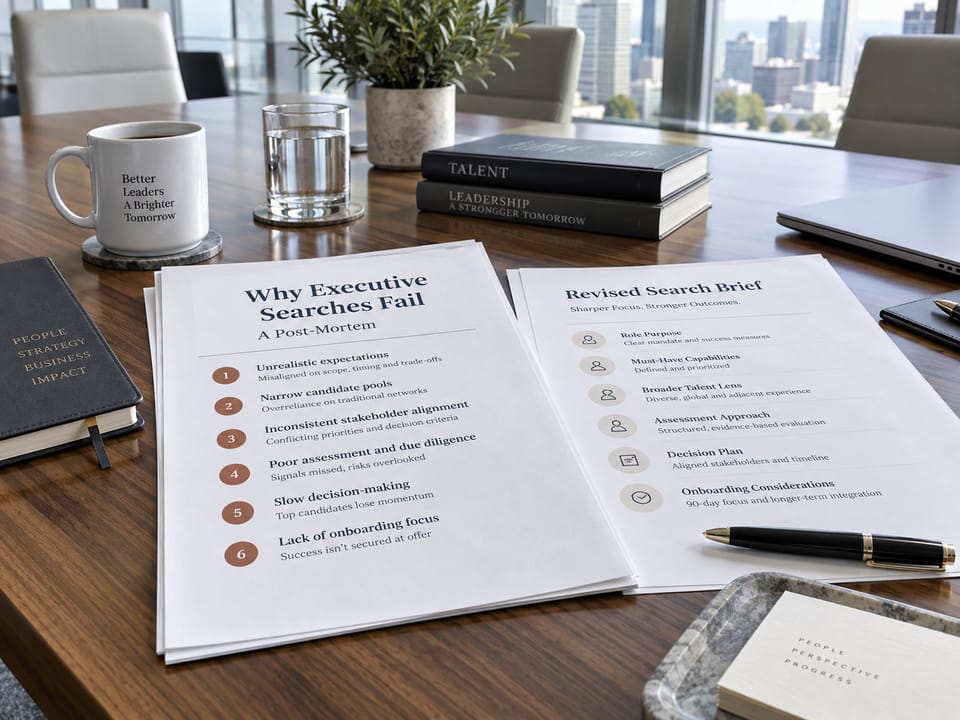

Executive search failure is not a talent problem. It’s a systems problem.
Companies rarely set out to make bad executive hires.
The resumes are strong.
The references check out.
The interviews feel rigorous.
And yet, executive search failure has quietly become the industry norm, not the exception.
This breakdown shows boards and leadership teams how to cut executive search failure rates down 70–75%.
The Silent Momentum Killer
Most companies don’t realize a hire has failed until months after the warning signs appear.
By then, momentum is already lost.
Research shows this to .
- 40–50% of executives fail within 18 months
- Most failures are identifiable within the first 6–12 months
- Many executives remain in role for two years or more
This is not about bad judgment or unlucky bets.
It is about a hiring system optimized for placement, not performance.
When the system is broken, even exceptional leaders fail inside it.
The uncomfortable truth about executive search failure
The industry assumption that keeps breaking companies
The prevailing assumption in executive hiring is simple:
If we find a “great” candidate and fill the seat, performance will follow.
The research demolishes this belief.
Across more than two decades of studies:
- 89% of executive failures are driven by cultural, political, and system factors
- Technical competence accounts for a minority of outcomes
Most failed executives were qualified to do the job.
They just could not succeed in that system, with those stakeholders, under those conditions.
Executive search failure is not random.
It is structurally engineered.
Executive search fails because the industry optimizes for filling roles instead of engineering executive performance inside complex systems.
Before we go any further, pause for a moment and think about the executive failures you’ve personally witnessed.
Root Cause #1: Hiring starts with a job description, not a diagnosis
Why most searches fail before they even begin
Job descriptions describe responsibilities.
They do not define outcomes.
They do not diagnose the system an executive is entering.
In practice, most searches begin with:
- A recycled job spec
- Conflicting stakeholder expectations
- Unspoken political landmines
- Undefined success metrics
The research is clear:
- 33% of executives fail because expectations with their boss were never clear
- 75% fail due to cultural misalignment
When the problem isn’t clearly defined, the hire can’t solve it, no matter how talented they are.
What actually goes wrong: The board hires for “the role,” not for the specific problem the business actually needs solved.
How it shows up
- The job spec lists activities, but nobody can name the three outcomes that would make the hire a win in 12 months.
- Stakeholders quietly optimize for different versions of the role (growth, control, transformation, stability).
- The candidate slate becomes a proxy war between factions instead of a solution path.
Compounding Costs
You don’t just waste a search cycle.
You install ambiguity at the top of the organization.
Decision-making slows.
Downstream execution drag becomes the norm.
What does this look like in the real world?
Company: Hewlett-Packard (HP)
Executive: Leo Apotheker, CEO
Mandate: Transform HP from a hardware-focused company into a software/enterprise company.
What went wrong:
- Transformation mandate misaligned to HP’s strategic reality
- Focused on software identity, not competitive advantage
- Fixated on Autonomy while deprioritizing WebOS
Impact:
- WebOS terminated within 7 weeks
- ~$1.2B value destruction
- ~40% stock decline in 11 months
Key lesson: Intelligence does not predict decision quality. Hiring without system diagnosis guarantees value destruction.
Root Cause #2: Stakeholder misalignment is treated as “soft,” not fatal
Politics don’t feel dangerous… until they are
Company: Nike
Executive: William D. Perez, CEO
Mandate: Bring operational discipline and mentor internal successors.
What went wrong:
- Founder authority remained unresolved
- Cultural mismatch with brand-led operating model
- Strategic disagreements with internal leaders became fatal
Impact:
- CEO exit within 13 months
- Loss of strategic momentum
Key lesson: If stakeholder power is unresolved, the role is unwinnable, regardless of talent.
How it shows up
Peer dynamics, board politics, and power structures are often dismissed as “soft issues.”
They are not.
- 52% of executive failures are caused by breakdowns with peers
- Peers are consistently the least supportive stakeholder group during onboarding
- Political misreads compound silently until trust is irreversibly damaged
Most executive searches never address this risk.
Candidates are evaluated in isolation while the system they must navigate remains unexamined.
What actually goes wrong: A capable executive is dropped into a politically misaligned system with no map.
How to diagnose it
If you asked three stakeholders, “What does success look like?” and got three different answers, the hire will inherit that conflict.
Why it compounds
Peer trust breaks first.
Not strategy.
Once peer dynamics sour, execution slows because cross-functional decisions become negotiations instead of decisions.
Root Cause #3: Overweighting pedigree and underweighting system fit
Why “great on paper” hires derail
Traditional search over-indexes on:
- Prior titles
- Brand-name companies
- Linear career progression
Yet technical skill accounts for only ~11% of executive failures.
What actually predicts success:
- Cultural navigation
- Emotional regulation
- Ability to read power dynamics
- Adaptability to ambiguous systems
These traits are rarely pressure-tested.
They’re inferred—often incorrectly.
What actually goes wrong: The industry selects for résumé excellence while ignoring contextual survivability.
What to stop rewarding
- “Similar company, same title” thinking as a substitute for context-fit evidence.
- Overconfidence fueled by pedigree—especially when the role requires coalition-building, not heroics.
What to start testing
- Can the candidate earn trust without formal authority?
- Can they absorb feedback without defensiveness?
- Can they operate inside ambiguity without creating chaos?
Let’s look at how this plays out in the real world
Company: J.C. Penney
Executive: Ron Johnson, CEO
Mandate: Reinvent the brand and modernize the retail experience.
What went wrong:
- Imported premium model into value retail context
- Eliminated promotions without behavioral testing
- Lost frontline and operational credibility
Impact:
- ~$4.3B revenue decline
- ~$1B losses
- Severe stock decline within 17 months
Key lesson: Past success in one system does not transfer to another. System fit beats pedigree.
Root Cause #4: External hires are treated the same as internal promotions
A statistically indefensible assumption
The research is unambiguous: external executives fail at 1.3–4× the rate of internal promotions, depending on methodology.
Despite this, most organizations provide:
- The same onboarding
- The same expectations
- The same timelines
External hires face:
- Unwritten rules
- Legacy alliances
- Cultural antibodies
- Zero margin for early missteps
What actually goes wrong: Organizations dramatically underestimate the integration risk of outsiders.
External executives are expected to perform before they are meaningfully integrated into the system they are meant to lead.
Why external hires get punished faster
Internals get contextual “grace.” Externals get judged on early signals.
Small misreads in the first 30–60 days are interpreted as “this won’t work,” and that perception spreads.
Once doubt sets in, interpretation bias takes over.
Neutral actions are read negatively.
Learning curves are reframed as incompetence.
By the time performance stabilizes, confidence has already decayed.
What that means operationally
External hires should come with a defined integration plan—not a generic onboarding checklist.
Sound familiar? Probably because you have seen this before
Company: Starbucks
Executive: Laxman Narasimhan, CEO
Mandate: Lead digital transformation and global expansion.
What went wrong:
- Outsider perspective misread coffeehouse operating culture.
- Limited understanding of frontline operational realities.
Impact:
- Strategic friction.
- Short tenure (18 months) ending in leadership reset.
Key lesson: External CEOs require intentional cultural integration, not standard onboarding.
Root Cause #5: The first 90–120 days are left to chance
Where failure becomes inevitable
Research shows:
- First impressions form within 30–60 days
- Behavior patterns lock by 90 days
- Long-term performance trajectories are 83% predictable by 120 days
Yet most executives are told to “figure it out.”
Without custom integration:
- Productivity drops 30–50%
- Teams hesitate
- Decision velocity slows
- Confidence erodes
What actually goes wrong: The most predictive window for success is unmanaged.
Have you ever known a hire was failing by month 9? And still kept them until month 24+?
How to diagnose it
The first four months aren’t “warm-up.” They are when confidence trajectories lock in.
In leadership transitions, early confidence is the leading indicator.
- If alignment is unclear by Day 30, expectations will drift.
- If peer trust isn’t building by Day 60, politics will fill the gap.
- If tangible wins aren’t visible by Day 90, confidence starts decaying.
- If the narrative isn’t positive by Day 120, recovery becomes slow and expensive.
Companies should review these signals on a 30/60/90/120-day cadence instead of waiting for lagging financial metrics.
Root Cause #6: Failure is recognized early—but acted on late
The 24-month momentum trap
One of the most damaging patterns in executive search failure is the delay between recognition and action.
- Failure is usually evident within 6–12 months
- Executives often remain in role 24+ months
- The organization absorbs 18–24 months of execution drag
What actually goes wrong: Organizations double down on sunk costs while momentum quietly bleeds out.
Early warning signals are acknowledged but rationalized, while execution drag compounds beneath the surface.
Why this happens:
- Board reluctance to admit a mistake
- Hope-based management
Why it compounds
Many companies don’t lack information. They lack a pre-agreed intervention trigger.
Without triggers, the org drifts into “wait and see” and pays for it in lost speed and credibility.
What does this look like inside a real company?
Company: CNN
Executive: Chris Licht, CEO (13 month tenure)
Mandate: Restore editorial neutrality and revive ratings.
What went wrong:
- Early newsroom trust erosion
- Cultural misalignment left unaddressed
Impact:
- Historically low ratings
- Newsroom morale collapse
- Turnaround credibility lost
Key lesson: When trust fails early, delayed intervention compounds the damage.
Root Cause #7: Search firms are paid for placement, not outcomes
Incentives drive behavior
Traditional executive search economics reward:
- Speed
- Placement
- Activity
They do not reward:
- Custom integration success
- Time-to-impact
- Retention
- Performance
The result is a transactional placement trap, where the search “ends” precisely when the real risk begins.
Why this repeats across companies
When payment is tied to placement, effort concentrates on sourcing and closing.
But the largest failure drivers (culture, politics, integration, momentum) sit after acceptance—where the traditional model stops measuring.
Placement is an event. Performance is a lifecycle.
This isn’t theoretical… here’s what it looks like
Company: Yahoo
Executive: Scott Thompson, CEO
Mandate: Reverse declining performance.
What went wrong:
- Resume misrepresentation went undetected.
- Search and board diligence failed.
Impact:
- Immediate reputational damage.
- Legal and governance exposure.
Key lesson: Placement is not success. Diligence and integrity cannot be outsourced.
Given that a failed executive costs $3.7M–$5.7M in total economic impact, stopping at placement is not neutral—it’s negligent.
Do these root causes sound familiar?
If they have, it’s because they all stem from the same flaw: the system was never designed to engineer executive performance.
Reducing executive search failure is risk engineering
Executive hiring is not a recruiting activity.
It is a risk transfer decision.
You are not buying access to candidates.
You are underwriting:
- Selection risk (~50%)
- Integration risk
- Momentum risk
- Reputation risk
- Opportunity cost
Organizations that reduce failure rates to 10–15% do one thing differently:
They treat executive search as performance engineering across the full lifecycle—not a transaction.
This is C-suite hiring risk management, not recruiting.
What boards can do differently
Treat the search mandate as a governance instrument, not a requisition.
Require a one-page success definition:
- The 3 outcomes that matter
- The constraints that exist
- The failure modes you are insuring against
Force stakeholder alignment before the role ever goes to market.
If success cannot be described consistently by the CEO, board chair, and key peers, you are recruiting into unresolved conflict.
Set integration as an explicit board-level deliverable.
- Require a 30/60/90/120-day plan
- Review progress as part of board cadence
Pre-commit intervention triggers.
- Define risk signals (peer breakdown, attrition spikes, decision paralysis)
- Define actions (coaching, facilitated alignment, role redesign)
Measure confidence, not just performance.
In early windows, confidence leads.
Lagging metrics arrive after damage is done.
What executive leadership teams can do differently
Build the system welcome, not just leader onboarding.
Before the executive arrives, define:
- How decisions get made
- How conflict gets handled
- What “good” looks like in the first 120 days
Engineer peer support deliberately.
- Assign 1–2 peer sponsors
- Schedule structured peer 1:1s
- Define cross-functional handshake agreements
Create a shared narrative fast.
If the team cannot explain why this leader was hired and what problem they are solving, the organization fills the gap with speculation.
Protect the first 60 days from noise.
- Reduce unnecessary meetings
- Clarify priorities
- Create space for listening and relationship-building
Surface friction early.
High-performing teams normalize early truth.
Small misalignments become political events when left unspoken.
The logical conclusion companies eventually reach
Executive search failure persists not because the problem is unsolved. It persists because the industry hasn’t structurally changed.
The data is settled. The failure patterns are repeatable. The costs are enormous. And the solution is not better interviews or faster searches.
It’s a different operating model. One that starts with system diagnosis, selects for contextual fit, and engineers momentum through the most fragile window of an executive’s tenure.
companies that make this shift don’t hire more often. They fail less often.
And in executive leadership, avoiding failure is the highest form of performance.
Reducing executive search failure requires a lifecycle operating model, not a placement event.
The difference between a 50% failure rate and a 10–15% failure rate is not better résumés or faster placement.
It comes from shifting away from:
- Hiring based on individual pedigree
- Defining “success” at placement
And deliberately moving toward:
- System diagnosis
- Custom integration
- Full-lifecycle support
That shift alone accounts for a 70–75% reduction in executive search failure.
The real failure isn’t a bad hire. It’s treating a high-risk leadership decision like a routine recruiting task.
FAQ — Executive Search Failure
What is executive search failure?
Executive search failure is when a C-suite hire fails to deliver expected performance, typically visible within 6–12 months and confirmed within 18 months. Research shows a 40–50% failure rate within 18 months.
Why do executive searches fail so often?
Executive search failure is usually caused by system and stakeholder misalignment—not a lack of talent. 89% of failures are driven by cultural and political factors, not lack of skill.
How much does a failed executive search cost?
A failed executive search typically costs $3.7M–$5.7M when you include disruption and opportunity loss.
Can executive search failure be prevented?
Yes—custom integration and lifecycle support can reduce executive search failure by roughly 70–75%.
Want more like this?
If you’re a board member, investor, or executive leader navigating a critical hire, subscribe to the newsletter for frameworks on reducing executive search failure and accelerating time-to-impact—without relying on luck.
What’s Next: Fixing the 90-Day Gap
We’ve established that 40–50% of executives fail because the first 90-120 days are left to chance.
So, how do you actually engineer those first three months for impact?
Next week, I’m breaking down the specific framework to fix this in: “The 90-Day Cliff: How to Protect Your $3.7M Executive Hire”
Follow the Link below to our LinkedIN Newsletter